
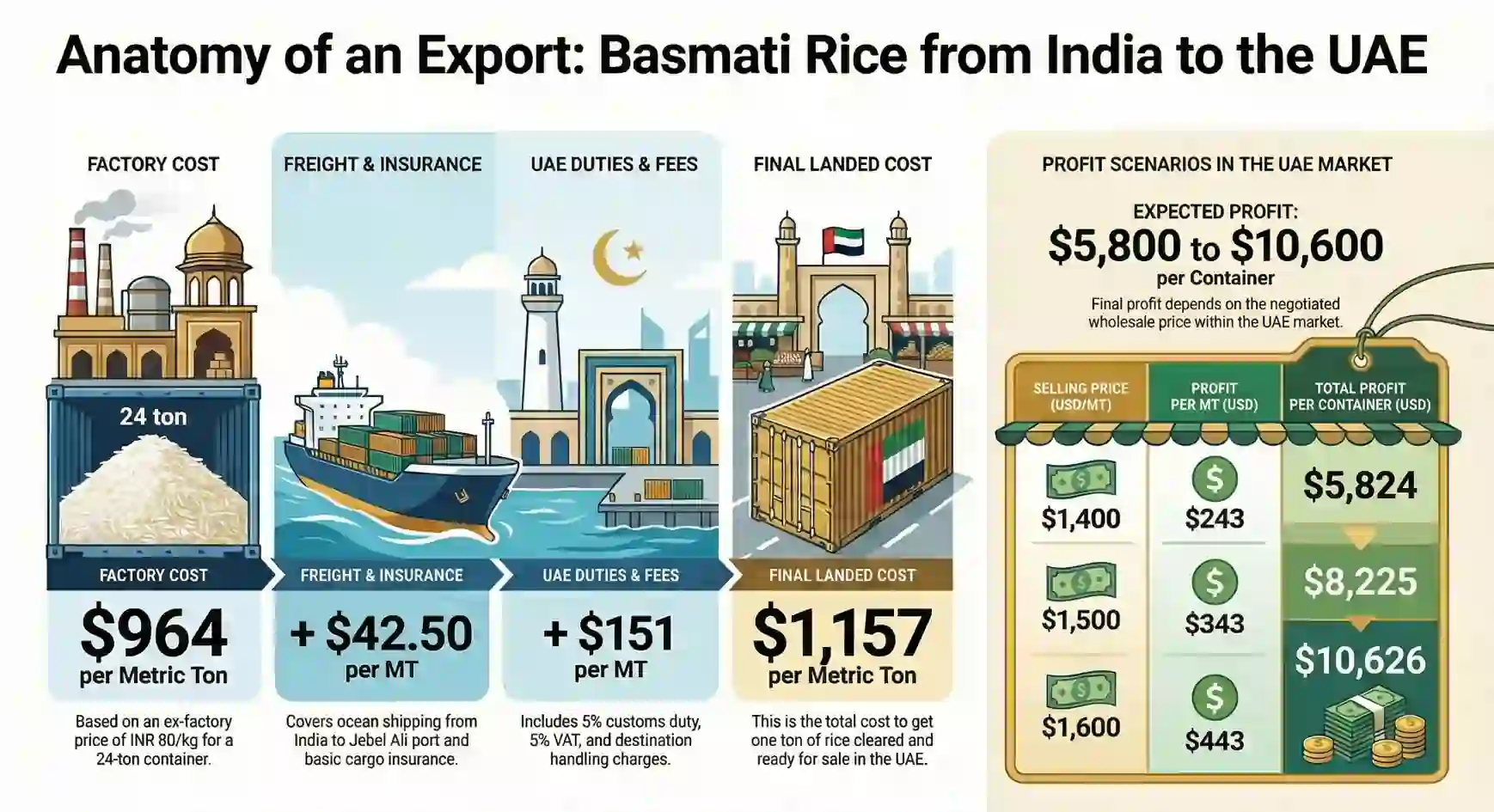
How much Profit in importing Basmati Rice from India to UAE for one 20ft container?
📦 Step 1: Container capacity
- A 20ft container typically carries 24 metric tons (MT) of bagged rice (≈ 24,000 kg).
💰 Step 2: Cost in India
- Ex‑factory price: INR 80/kg
- Total cost (24,000 kg):
[ 24{,}000 \times 80 = 1{,}920{,}000 \text{ INR} ]
💱 Step 3: Convert to USD
- Assume exchange rate: 1 USD ≈ INR 83 (Dec 2025 average).
- FOB cost in USD:
[ \frac{1{,}920{,}000}{83} \approx 23{,}133 \text{ USD} ] - Per MT:
[ \frac{23{,}133}{24} \approx 964 \text{ USD/MT} ]
🚢 Step 4: Freight & insurance
- Ocean freight (India → Jebel Ali, 20ft): ≈ USD 900/container (≈ 37.5 USD/MT).
- Insurance: 0.5% of cargo value ≈ 5 USD/MT.
- CIF cost per MT:
[ 964 + 37.5 + 5 \approx 1{,}006.5 \text{ USD/MT} ]
🏛 Step 5: UAE import duty & VAT
- Customs duty: 5% of CIF = 50.3 USD/MT.
- VAT: 5% of (CIF + duty) = 53.0 USD/MT.
- Destination handling & clearance: ≈ 47.5 USD/MT.
- Total landed cost per MT:
[ 1{,}006.5 + 50.3 + 53.0 + 47.5 \approx 1{,}157.3 \text{ USD/MT} ]
🛒 Step 6: Selling price in UAE
Recent wholesale basmati prices in UAE range USD 1,400–1,600/MT depending on grade and packaging.
📊 Step 7: Profit scenarios
| Selling price (USD/MT) | Landed cost (USD/MT) | Profit per MT | Profit per container (24 MT) |
|---|---|---|---|
| 1,400 | 1,157.3 | 242.7 | 5,824 |
| 1,500 | 1,157.3 | 342.7 | 8,225 |
| 1,600 | 1,157.3 | 442.7 | 10,626 |
✅ Conclusion:
At INR 80/kg ex‑factory, you can expect USD 5,800–10,600 profit per 20ft container depending on your UAE selling price.
India has long been celebrated for its rich agricultural heritage, and among its many prized exports, Basmati rice holds a special place. Revered for its aromatic fragrance, slender grains, and unmatched flavor, Basmati rice is a staple in kitchens around the world. For businesses looking to import high-quality Basmati rice, understanding the market, regulations, logistics, and sourcing practices is essential.
In this comprehensive guide, we explore the essentials of importing Basmati rice from India, highlight the global demand landscape, outline key import procedures, and introduce ALNADIM EXIM, a trusted and leading exporter committed to delivering premium-grade Basmati rice to international markets.
1. Introduction to Basmati Rice
Basmati rice is a globally cherished long-grain rice variety native to the Indian subcontinent. The word “Basmati” translates to “fragrant” or “full of aroma” in Hindi, reflecting the rice’s signature characteristic. With its delicate texture, long slender grains, and exceptional aroma, Basmati rice has gained international acclaim among consumers, chefs, and food industry professionals.
India accounts for approximately 70% of the world’s Basmati rice production and is recognized as the leading exporter of the authentic variety. The combination of unique soil conditions, Himalayan river water, and traditional farming practices makes Indian Basmati rice unparalleled in quality and taste.
2. Why Import Basmati Rice from India?
Importing Basmati rice from India offers significant advantages for international businesses:
2.1 Authentic Quality and Aroma
India is home to the original Basmati-growing regions. Authentic Basmati rice grown here has a natural aroma and grain elongation unmatched by competing varieties.
2.2 Wide Variety of Grades
Indian exporters offer a broad selection of Basmati rice types such as:
- Traditional Basmati Rice
- 1121 Basmati Rice
- 1509 Basmati Rice
- Pusa Basmati Rice
- Sella (Parboiled) Basmati Rice
- Steam Basmati Rice
This diversity allows importers to choose varieties suited to their market’s preferences.
2.3 Competitive Pricing
India’s large-scale production and efficient export supply chains provide competitive pricing without compromising quality.
2.4 High Production Standards
Indian rice mills follow stringent quality control measures, often adhering to international certifications like ISO, HACCP, FSSAI, and APEDA guidelines.
2.5 Reliable Supply Chain
India’s established logistics infrastructure supports consistent and timely global deliveries.
3. Global Demand for Basmati Rice
The global market for Basmati rice has witnessed substantial growth over the past decade. With rising consumer preference for healthy, aromatic, and premium rice varieties, Basmati’s popularity has surged in regions such as:
- Middle East
- Europe
- North America
- Africa
- Southeast Asia
The health benefits of Basmati—low glycemic index, high fiber content, and rich nutritional profile—have amplified its demand among health-conscious consumers.
4. Key Factors to Consider When Importing Basmati Rice
Importing agricultural products requires careful evaluation to ensure product quality, legal compliance, and smooth logistics. Here are the essential factors importers should consider:
4.1 Exporter Verification
Choose a reputable exporter like ALNADIM EXIM, known for transparency, quality assurance, and adherence to export regulations.
4.2 Quality Specifications
Basmati rice quality is determined by:
- Grain length
- Aroma level
- Whiteness and purity
- Broken percentage
- Moisture content
- Milling process
4.3 Packaging Requirements
Export packaging options include:
- 1kg, 5kg, 10kg consumer packs
- 20kg, 25kg bulk bags
- 50kg jute or PP bags
- Customized private-label packaging
4.4 Import Regulations
Each country has its own import guidelines such as:
- Phytosanitary certificates
- Food safety compliance
- Labeling requirements
- Customs duties and import taxes
4.5 Logistics and Shipping
Basmati rice is commonly shipped via sea freight in containerized loads. Factors influencing shipping include:
- Incoterms (FOB, CIF, EXW)
- Transit time
- Port handling charges
- Freight insurance
5. Step-by-Step Guide to Importing Basmati Rice
Importing Basmati rice from India can be simplified by following these steps:
5.1 Step 1: Identify Your Market Requirements
Understand demand patterns, consumer preferences, and pricing trends in your target market.
5.2 Step 2: Contact a Trusted Exporter
Reach out to an experienced exporter like ALNADIM EXIM to discuss product specifications, packaging, pricing, and minimum order requirements.
5.3 Step 3: Request Samples
Product samples help verify aroma, grain length, cooking quality, and overall appearance.
5.4 Step 4: Negotiate Terms
Discuss:
- Payment terms (TT, LC, etc.)
- Delivery schedules
- Packaging details
- Documentation support
5.5 Step 5: Finalize the Purchase Contract
Ensure the contract includes all key details such as shipment date, quality specifications, and payment terms.
5.6 Step 6: Shipping and Documentation
Exporters typically provide necessary documents including:
- Invoice
- Packing list
- Bill of lading
- Certificate of origin
- Phytosanitary certificate
- Quality certificate
5.7 Step 7: Clearing Customs in Your Country
Work with your customs broker to ensure timely clearance.
5.8 Step 8: Receive, Store, and Distribute
Once goods are received, store them in dry and hygienic conditions to maintain freshness.
6. Why Choose ALNADIM EXIM as Your Basmati Rice Export Partner?
ALNADIM EXIM is a reputable name in the global agricultural export industry, known for delivering high-quality Basmati rice that meets international food standards. Importers across multiple countries trust ALNADIM EXIM for its consistent quality, flexible shipping options, and exceptional customer service.
Here’s what sets ALNADIM EXIM apart:
6.1 Premium-Grade Basmati Rice
The company sources rice from the best farms and mills in India, ensuring long-grain, aromatic, and authentic Basmati varieties.
6.2 Advanced Processing and Milling
State-of-the-art milling and polishing technologies ensure uniform grain consistency and purity.
6.3 Tailored Packaging Solutions
From consumer retail packs to bulk bags, ALNADIM EXIM offers packaging tailored to your business needs.
6.4 Strict Quality Control
Each batch undergoes rigorous inspection for grain length, moisture, purity, and aroma before final dispatch.
6.5 Competitive Pricing Structure
Their optimized supply chain enables cost-effective pricing.
6.6 Global Shipping Expertise
Whether you need FOB, CIF, or custom shipping arrangements, ALNADIM EXIM ensures timely delivery.
6.7 End-to-End Support
The company provides full support on documentation, customs compliance, private branding, and logistics coordination.
7. Understanding the Different Types of Basmati Rice Exported by ALNADIM EXIM
7.1 1121 Basmati Rice
Known for its extra-long grains, this is the most popular Basmati variety globally.
7.2 1509 Basmati Rice
Light, fluffy, and aromatic—ideal for biryani and pulao.
7.3 Traditional Basmati Rice
The classic variety preferred for its authentic flavor.
7.4 Pusa Basmati Rice
A hybrid variety offering a balance of quality and affordability.
7.5 Sella (Parboiled) Basmati Rice
Available in white, golden, and creamish-yellow varieties, known for high nutritional value.
7.6 Steamed Basmati Rice
Perfect for consumers seeking a polished and clean grain appearance.
8. Documentation Required for Importing Basmati Rice
When importing Basmati rice, proper documentation ensures smooth customs clearance:
- Commercial Invoice
- Packing List
- Certificate of Origin
- Phytosanitary Certificate
- Fumigation Certificate
- Bill of Lading or Airway Bill
- Insurance Certificate
- Other country-specific food safety documents
ALNADIM EXIM provides complete assistance in preparing these documents with accuracy.
9. Shipping, Packaging, and Logistics
9.1 Shipping Modes
Basmati rice is commonly shipped in:
- 20-foot containers
- 40-foot containers
9.2 Packaging Materials
- Non-woven bags
- PP woven bags
- Jute bags
- BOPP laminated bags
- Vacuum-sealed packs
9.3 Loadability
Typical load capacity:
- 20ft container: 24–25 metric tons
- 40ft container: 26–27 metric tons
9.4 Shipping Time
Average transit durations:
- Middle East: 7–14 days
- Europe: 20–28 days
- Africa: 18–30 days
- USA/Canada: 25–40 days
10. Challenges in Importing Basmati Rice and How ALNADIM EXIM Helps
10.1 Quality Mismatch
Some buyers face discrepancies between sample and actual shipment. ALNADIM EXIM ensures batch-wise quality checks and transparency.
10.2 Delayed Shipments
Unpredictable factors can slow freight. With strong logistics partners, ALNADIM EXIM ensures timely deliveries.
10.3 Customs Issues
Documentation errors can cause delays. ALNADIM EXIM provides correct and complete paperwork.
10.4 Market Price Fluctuations
With strong sourcing networks, ALNADIM EXIM offers stable pricing.
11. Conclusion
Importing Basmati rice from India presents a valuable opportunity for global businesses aiming to supply customers with premium-quality, aromatic rice. By partnering with a trusted exporter like ALNADIM EXIM, importers gain access to exceptional rice varieties, competitive prices, reliable shipments, and comprehensive support.
Whether you are a retailer, wholesaler, distributor, or food industry buyer, ALNADIM EXIM stands as a dependable partner delivering the true taste of Indian Basmati rice to your doorstep.
For inquiries, quotations, or partnership opportunities, consider connecting with ALNADIM EXIM—your trusted gateway to premium Basmati rice from India.
We are the Exporter of Best Quality of Basmati Rice from India. We procure Directly from the Farmers so the Price is unmatched with Best Quality.
Contact Whats app + 91 7045184773
Email [email protected]