
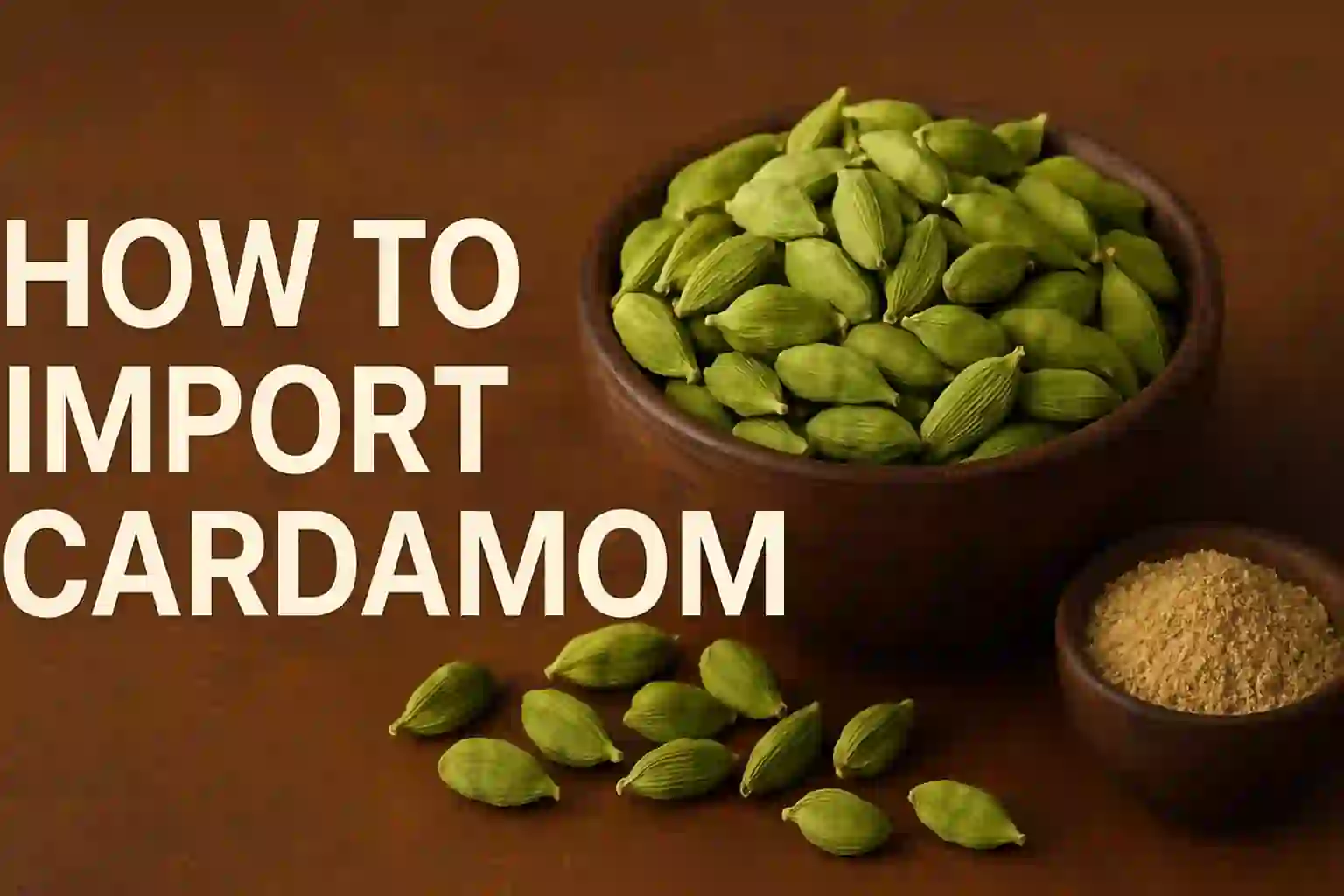
How to Import Cardamom:
The Complete 2025 Guide (Step-by-Step + Documents + Suppliers + Costs)
1. Introduction
Cardamom, often called the “Queen of Spices,” is one of the most valuable aromatic spices in global trade. From food processing companies and spice manufacturers to wholesalers and retailers, international demand for cardamom has been consistently rising.
At ALNADIM EXIM LLP, we specialize in sourcing and exporting premium-quality spices, including Green Cardamom and Black Cardamom. With our industry expertise, we’ve created this comprehensive guide for businesses, traders, and individuals who want to import cardamom safely, legally, and profitably.
Cardamom is one of the world’s most valuable spices—often called the “Queen of Spices.”
Demand has skyrocketed globally due to its use in:
- Food and beverages
- Bakery and confectionery
- Ayurvedic and herbal medicines
- Essential oils and perfumes
- Coffee and tea blends
- FMCG flavoring
If you want to import cardamom from top-producing countries such as Guatemala, India, Nepal, Sri Lanka, or Tanzania, you need a proper understanding of international trade regulations, documentation, grading, and quality control.
This guide gives you everything you need, from finding suppliers to calculating landed cost, to avoid loss and ensure profitable imports.
2. What Is Cardamom? A Quick Overview
Cardamom belongs to the Zingiberaceae family (same as ginger).
There are two main types:
- Green Cardamom (Elettaria cardamomum) – premium, aromatic
- Black Cardamom (Amomum subulatum) – smoky, stronger flavor
Cardamom is sold in many forms:
- Whole pods
- Seeds
- Powder
- Oil
- Oleoresin
As an importer, understanding the type, grade, and origin helps you choose the right product for your target market.
3. Global Market Overview: Why Import Cardamom in 2025?
3.1 Rising Global Consumption
Cardamom demand has increased in:
- Middle East (highest consumption per capita)
- Europe (flavored tea & bakery)
- US & Canada (coffee blends, health products)
- Asia (food & ayurveda)
3.2 High Profit Potential
Cardamom margins range from 20% to 60% depending on grade, season, and importing country.
3.3 Supply–Demand Gap
Global production fluctuates due to:
- Weather sensitivity
- High cultivation costs
- Labour-intensive harvesting
Importing cardamom at the right time gives traders huge profitability.
4. Types of Cardamom You Can Import
4.1 Green Cardamom (Most Popular in Global Trade)
Grades include:
- Super Bold (8 mm+)
- Bold (7–8 mm)
- Superior / AAA
- Fancy / A Grade
- AGEB / AGS / AGS 1
- Small / Medium / Mix Quality
4.2 Black Cardamom
Used in:
- Masala blends
- Biryanis
- Pickles
- Traditional medicine
4.3 Ground Cardamom Powder
Higher risk of adulteration; ensure lab testing.
4.4 Cardamom Oil & Oleoresin
High-value products for pharmaceuticals and perfumes.
5. Major Cardamom Producing Countries
5.1 Guatemala (Largest Producer)
- Best for bulk & competitive prices
- Grades: Mixed, Bold, Green, and Superior
5.2 India
- Known for premium quality
- Main regions: Kerala, Karnataka, Tamil Nadu
5.3 Nepal
- Famous for Black Cardamom
- Strong aroma, widely exported to China & Middle East
5.4 Sri Lanka
- High-flavor green cardamom, niche market
5.5 Tanzania / Laos / Vietnam
- Growing global presence
6. How to Choose a Reliable Cardamom Supplier
Checklist
✔ Check exporter license
✔ Verify trade history (B2B platforms, customs data)
✔ Ask for lab test reports
✔ Inspect product samples
✔ Confirm moisture and pesticide levels
✔ Evaluate packaging standards
✔ Check warehouse and drying facility
✔ Request references from previous buyers
Where to Find Suppliers
- Spices Board Listings
- Export Promotion Councils
- Direct farm networks
- Spice fairs (Gulfood, BioFach, SIAL)
7. Step-by-Step Process to Import Cardamom
Step 1: Register Your Import Business
Depending on your country:
- Import license
- Business trade certificate
- GST/VAT registration
- IEC number (India)
Step 2: Identify the Cardamom Type & Quantity
Decide:
- Whole pods or powder
- Green or black
- Grade (e.g., 7mm premium)
- Required monthly volume
Step 3: Get Quotations From Suppliers
Ask for:
- FOB price
- MOQ
- Payment terms
- Delivery time
- Packaging details
Step 4: Request Samples
Check:
- Aroma
- Color
- Moisture content
- Size consistency
- Absence of mold
Step 5: Negotiate Price and Terms
Standard payment methods:
- LC (Letter of Credit)
- TT advance + balance after inspection
- Escrow (for small orders)
Step 6: Finalize Contract
Include:
- Quality parameters
- Moisture limits
- Packaging standards
- Penalty clause
- Delivery timeline
Step 7: Arrange Inspection
Third-party inspectors:
- SGS
- Intertek
- Bureau Veritas
Step 8: Shipping & Logistics
Modes:
- Sea freight (cheapest for bulk)
- Air freight (fast, expensive)
Step 9: Customs Clearance
Provide documents:
- Bill of lading
- Invoice
- COO
- Health certificates
Step 10: Receive Cargo & Quality Check
Ensure product meets contract standards.
8. Documents Required to Import Cardamom
Exporter Documents
- Invoice
- Packing list
- Phytosanitary certificate
- Certificate of Origin
- Fumigation certificate
- Lab test report
- Insurance
Importer Documents
- Import license
- Bill of Entry
- Tax registration (GST/VAT)
- Purchase order
- Customs duty payment
Mandatory Food Safety Documents
- FDA (for U.S.)
- FSSAI (for India)
- EU Food Safety Certificate
9. Packaging, Grading & Quality Standards
Packaging Options
- 5 kg, 10 kg, 25 kg bags (food-grade)
- Vacuum packing for premium grades
- Moisture-proof poly bags
Quality Parameters
- Moisture < 11%
- No mold, pests, or fungus
- Uniform color
- Proper drying
- No adulteration
10. Import Duty, HS Codes & Tariffs
HS Code for Cardamom
- 090831 – Green Cardamom
- 090832 – Black Cardamom
- 090830 – Ground cardamom
Duties vary by country:
- Custom duty
- Import tax (GST/VAT)
- Port charges
- FSSAI/FDA fees
11. Shipping Methods & Cost Breakdown
Sea Freight
Most economical for quantities above 500 kg.
Air Freight
Used for urgent shipments or premium grade (super bold).
Cost Components
- Spice cost
- Packaging
- Inland transport
- Freight
- Port handling
- Duty
- Customs brokerage fees
Landed Cost Calculation
Landed cost =
Product price + Freight + Insurance + Duty + Taxes + Clearing Charges
12. Common Mistakes Importers Make
❌ Not inspecting goods before shipment
❌ Buying powder → highest adulteration risk
❌ Ignoring moisture levels
❌ Not understanding seasonal price fluctuations
❌ Not verifying supplier authenticity
13. How to Avoid Fraud When Importing Spices
- Buy only from registered exporters
- Use LC for high-value orders
- Verify with customs export data
- Request video inspection
- Avoid unrealistically low prices
- Use third-party QA teams
14. Storage, Handling & Shelf Life
Ideal Storage
- Cool, dry place
- Airtight containers
- Away from sunlight
Shelf Life
- Whole pods: 12–24 months
- Powder: 6 months
- Oil: 2–3 years
15. Profit Margin in Cardamom Import Business
Typical margins:
- Retail: 20–40%
- Wholesale: 10–25%
- Premium grades: 40–60%
Margins vary depending on:
- Season
- Grade
- Country of origin
- Shipping costs
Below is a 100% unique, polished, SEO-optimized blog tailored to your brand voice for ALNADIM EXIM LLP — professional, trustworthy, globally minded, and export-import focused.
This version is written in a premium corporate tone suitable for your website or LinkedIn.
(If you want it stretched to 5,000+ words or formatted for WordPress, tell me.)
At ALNADIM EXIM LLP, we understand that cardamom is more than just a spice—it is a global commodity that drives massive demand across food, FMCG, beverage, pharmaceutical, and wellness industries. As global consumption increases every year, importers are looking for reliable ways to source premium-quality cardamom at competitive rates.
This guide is designed specifically for businesses and entrepreneurs who want to start or scale their cardamom import operations. With over a decade of combined trade experience, ALNADIM EXIM LLP brings clarity, structure, and actionable insights that help you import confidently and compliantly.
Why Import Cardamom in 2025?
1. Consistent Global Demand
Cardamom remains one of the top-selling spices across the Middle East, Europe, Asia, and America. Its use in tea, coffee blends, bakery items, confectionery, fragrances, and herbal medicines keeps demand strong year-round.
2. High Profit Margins
Cardamom is a premium crop. Depending on the grade and origin, importers typically earn 20%–60% profit margin, making it a highly lucrative commodity.
3. Supply Challenges Create Opportunities
Because cardamom is extremely sensitive to climate, global production fluctuates—creating seasonal price gaps that smart importers can capitalize on.
As ALNADIM EXIM LLP, we specialize in identifying the right sourcing windows so our clients benefit from the best quality at the right price.
Understanding Cardamom: Types & Grades
Before importing, it is essential to know what the market wants. Cardamom is available in different forms, and each one serves a unique purpose.
1. Green Cardamom (Premium Grade)
Preferred in:
- Gulf countries
- USA & Europe
- Food & beverage industries
Common grades:
- Super Bold (8mm+)
- Bold (7–8mm)
- AGEB / AGS
- A / B / C commercial mixes
2. Black Cardamom
Widely consumed in:
- India, Nepal, Bangladesh
- Masala manufacturers
- Meat processing
3. Cardamom Powder
Useful for:
- Bakeries
- Tea/coffee premixes
- Ice-cream manufacturers
4. Essential Oil & Oleoresin
High-value extracts used in:
- Perfumes
- Ayurveda
- Pharmaceuticals
At ALNADIM EXIM LLP, we source each variety through verified farms, trusted processors, and certified exporters globally.
We are the Supplier of Best Quality CARDAMOM at best price sourcing directly from the farmers.
Contact email [email protected] of Whats app + 91 7045184773
Best Countries to Import Cardamom From
1. Guatemala
World’s largest producer with attractive pricing for bulk buyers.
Perfect for wholesalers and repackagers.
2. India
Known for premium aroma, rich flavor, and uniform grading.
Ideal for high-end retail and FMCG brands.
3. Nepal
Specializes in smoky, aromatic Black Cardamom with export-grade quality.
4. Sri Lanka, Tanzania & Vietnam
Upcoming suppliers gaining global visibility.
At ALNADIM EXIM LLP, we maintain a vetted supplier network across all these markets ensuring consistent supply and premium quality.
How to Import Cardamom (Step-by-Step Guide)
This structured process is tailored to make importing easier, even for beginners.
Step 1: Business Registration & Import License
You will need:
- Import Export Code (IEC)
- Business registration
- GST/VAT (depending on your country)
- Food safety registration
ALNADIM EXIM LLP helps clients understand documentation requirements based on their destination country.
Step 2: Identify Cardamom Grade & Target Market
Ask yourself:
- Who is buying from you?
- Do they need green or black?
- Retail or industrial use?
- Premium or price-sensitive quality?
We assist with selecting the right grade based on your customer segment.
Step 3: Request a Quotation From Verified Suppliers
A proper quotation includes:
- FOB price
- Packaging
- Moisture %
- Payment terms
- HS code
- Transit time
With our global network, ALNADIM EXIM LLP ensures transparent, competitive, and verified pricing.
Step 4: Sample Evaluation
Check:
- Aroma
- Color consistency
- Pod size
- Moisture
- Freshness
- Drying quality
We coordinate sample dispatch and quality checks through certified labs if required.
Step 5: Contract, Payment & Final Negotiation
We recommend:
- LC (Letter of Credit) for large shipments
- Advance + balance after inspection for medium orders
- Secure Escrow options for new buyers
ALNADIM EXIM LLP assists in drafting trade-safe contracts.
Step 6: Third-Party Inspection
Inspection companies include:
- SGS
- Intertek
- Bureau Veritas
We arrange end-to-end QC to protect your investment.
Step 7: Shipping & Logistics Management
You can choose:
- Sea Freight (cheapest for bulk)
- Air Freight (fastest for premium retail orders)
We manage:
- Freight booking
- Insurance
- Port handling
- Export documentation
Step 8: Customs Clearance & Local Delivery
Documents required:
- Invoice
- Packing list
- Phytosanitary certificate
- Certificate of Origin
- Fumigation certificate
- Bill of Lading
- Insurance copy
We support smooth clearance with minimal delays.
Quality Standards & Compliance
Global Quality Benchmarks
- Moisture < 11%
- Uniform color
- Zero mold or fungus
- Food-grade packaging
- No pesticide contamination
Certifications We Work With
- ISO
- HACCP
- FSSAI
- FDA
- GMP
- Organic certifications
ALNADIM EXIM LLP ensures your cargo meets your country’s compliance standards.
Profit Margins in Cardamom Import Business
Margin varies by grade, season, and market.
Typical profits:
- Wholesale: 10–25%
- Retail: 20–40%
- Premium grades: 40–60%
Our clients often achieve higher margins through strategic sourcing windows we identify for them.
Here are the main challenges faced in cardamom import, explained clearly and practically so you can anticipate and avoid them:
We are the Supplier of Best Quality CARDAMOM at best price sourcing directly from the farmers in Bulk.
Contact email [email protected] of Whats app + 91 7045184773
Top Challenges in Cardamom Import
1. High Price Volatility
Cardamom prices fluctuate heavily due to:
- Seasonal supply
- Weather conditions
- Crop failures
- Export restrictions
- Market speculation
Price may rise or fall sharply within weeks, affecting profit margins.
2. Quality Inconsistency
Common quality problems:
- Color fading
- High moisture content
- Mold/fungal contamination
- Mixed or adulterated grade
- Inaccurate size grading
Without proper supplier verification, buyers may receive lower grade material.
3. Moisture & Fungus Issues During Shipping
Cardamom easily absorbs moisture.
If packing is poor:
- Pods turn pale
- Fungus develops
- Aroma reduces
Quality deteriorates quickly, especially in long sea shipments.
4. Fraudulent or Unreliable Suppliers
Some traders:
- Ship different quality than agreed
- Mix high-grade with low-grade
- Ask for full payment and disappear
- Provide fake documents
New importers are especially at risk.
5. Complicated Import Documentation
Cardamom requires:
- Phytosanitary certificate
- Certificate of origin
- Fumigation certificate
- Lab tests
- Customs declarations
Incorrect paperwork leads to:
- Port delays
- Demurrage charges
- Rejection or return of goods
6. Customs Clearance Delays
Reasons include:
- Missing documents
- Incorrect HS code
- Random customs inspection
- Food safety authority checks
Delays increase storage costs and damage quality.
7. High Import Duties & Taxes
Depending on the country, duties can be high.
This increases the landed cost, affecting competitiveness.
8. Shipping Delays & Logistics Issues
Problems include:
- Container shortages
- Port congestion
- Weather delays
- Increased freight rates
These factors disrupt delivery schedules.
9. Poor Packaging From Exporter
If cardamom is packed in:
- Thin bags
- Improper sealing
- Non–moisture-proof sacks
…it can lose aroma and color.
10. Aflatoxin & Food Safety Compliance
Some countries (EU, USA, Middle East) have very strict limits for:
- Aflatoxin
- Pesticide residues
- Microbial load
Non-compliance leads to:
- Shipment rejection
- Re-export
- Heavy financial loss
11. Currency Exchange Fluctuation
Exchange rate changes affect:
- Profitability
- Cost planning
- Contract stability
12. Limited Supplier Transparency
Some exporters avoid sharing:
- Origin details
- Farm sources
- Test reports
- Packaging specs
This makes quality assurance difficult.
13. Political or Trade Restrictions
Export bans or government policies in producing countries can disrupt supply.
Summary
Importing cardamom is profitable but involves challenges such as:
- Price swings
- Quality risks
- Supplier fraud
- Documentation issues
- Customs delays
- Food safety compliance
With the right exporter, inspection, and documentation, these challenges can be minimized.
Importing cardamom from India to the USA can be highly profitable, but the exact profit depends on several cost components such as sourcing price, freight, duty, packaging, and market selling price.
Below is a clear, practical profit calculation based on current industry averages (not real-time pricing).
✅ Typical Profit Margin When Importing Cardamom India → USA
Most importers make 15% to 40% profit, depending on:
- Grade (6mm, 7mm, 8mm)
- Quantity
- Packaging
- Target customers (wholesalers vs. retailers)
- Selling channel (Amazon, distributors, spice stores, food processors)
Premium grades like 7.5mm+ and 8mm offer the highest margins.
📌 Sample Profit Calculation (Realistic Example)
Below is a step-by-step calculation to estimate your profit.
⭐ 1. Cost in India (per kg)
- FOB India price for Green Cardamom (7–8mm): $23–$32 per kg
- Average: $28 per kg
⭐ 2. Freight Cost (Sea Freight to USA)
- Sea shipping (large shipment): $0.8–$1.2 per kg
Use average: $1.0 per kg
⭐ 3. USA Import Duty
- Typical customs duty on cardamom entering USA: 0–3%
Use 2% for estimate:
→ 2% of $28 = $0.56 per kg
⭐ 4. USA Port Charges + Customs Broker
- $400–$600 per shipment
Approx: $0.50 per kg
⭐ 5. Local Transport + Warehouse + Misc
Approx: $0.50 per kg
📌 Total Landed Cost in USA
FOB India: $28.00
Freight: $1.00
Duty: $0.56
Port + Broker: $0.50
Local logistics: $0.50
👉 Total Landed Cost = $30.56 per kg (rounded to $31)
📌 Selling Price in USA
Cardamom retail/wholesale price in USA:
| Market Type | Selling Price |
|---|---|
| Wholesaler bulk 25+ kg | $38–$48 per kg |
| Ethnic grocery stores | $50–$65 per kg |
| Amazon retail packs | $70–$110 per kg |
| Premium organic retail | $110–$125 per kg |
Let’s use wholesale (the safest assumption):
👉 Selling Price (Wholesale) = $45 per kg
📌 Your Profit per kg
Selling price: $45
Landed cost: $31
👉 Profit = $14 per kg
💰 Profit Margin = ~45% (gross)
📌 Profit for a 1-ton shipment (1,000 kg)
$14 profit × 1,000 kg = $14,000 profit per shipment
📌 Profit for a 5-ton shipment
$14 × 5,000 kg = $70,000 profit
🎯 What Increases Profit?
- Selling small packs (100g, 200g) instead of bulk
- Adding private label packaging
- Selling on Amazon USA
- Importing bigger sizes (7.5mm–8mm)
- Offering organic-certified varieties
- Targeting Arab, Indian, Pakistani communities in USA
Retail packaging can double or triple the profit.
🎯 What Reduces Profit?
- Poor quality or color fading
- High freight cost
- Excessive moisture or fungus
- Selling only to large wholesalers
- Market price fall
⭐ Final Answer (Easy Summary)
💵 Profit importing cardamom from India to USA:
➡️ $12–$18 profit per kg
➡️ 15–40% margin
➡️ $14,000 profit per 1-ton shipment
Below is a clear, realistic, and practical profit calculation for importing cardamom from India to the United Kingdom (UK).
This includes all major costs, typical UK selling prices, and final margin estimates.
✅ Average Profit Margin When Importing Cardamom India → UK
Most importers make:
18% to 45% profit margin
(depending on grade, packaging, and sales channel)
Premium grades (7.5mm to 8mm) give the highest profit.
📌 Sample Profit Calculation (Realistic Example)
Below is a detailed, step-by-step breakdown.
⭐ 1. Cost in India (per kg)
Indian Green Cardamom (7–8 mm):
- $23–$32 per kg FOB India
Average assumed: $28 per kg
⭐ 2. Freight Cost (Sea Freight to UK)
Large shipments:
- $0.70–$1.20 per kg
Use average: $1 per kg
⭐ 3. UK Import Duty + VAT
Import Duty
For HS code 0908:
- UK duty ranges 0–8%, depending on agreements.
Average: 5%
→ Duty = 5% of $28 = $1.40 per kg
VAT
UK VAT = 20%
VAT is charged on (Cost + Duty + Freight), but importers reclaim VAT later, so VAT does not reduce actual profit.
(So we will ignore VAT in profit calculations.)
⭐ 4. UK Port Charges + Customs Broker
- £350–£600 per container
Approx average: $0.50 per kg
⭐ 5. Local Transport + Warehouse + Misc
Approx: $0.60 per kg
📌 Total Landed Cost in UK per kg
FOB India: $28.00
Freight: $1.00
Duty: $1.40
Port + Broker: $0.50
Local logistics: $0.60
👉 Total Landed Cost = $31.50 per kg
⭐ 6. Selling Price of Cardamom in the UK
Cardamom is very expensive in the UK market.
| Market Type | Selling Price (per kg) |
|---|---|
| Bulk wholesale (10–25kg bags) | $40–$55 |
| Ethnic stores (Asian, Middle Eastern) | $60–$80 |
| Branded retail packs | $85–$120 |
| Organic premium packs | $120–$150 |
We will use the most realistic average wholesale price: $50/kg.
⭐ 7. Profit per kg
Selling Price: $50
Landed Cost: $31.50
👉 Profit = $18.50 per kg
👉 Profit Margin = ~37%
📌 Profit for 1-Ton Shipment (1,000 kg)
$18.50 × 1,000 =
⭐ $18,500 profit
📌 Profit for 5 Tons
$18.50 × 5,000 =
⭐ $92,500 profit
🎯 What Can Increase Profit?
- Selling smaller packs (100g, 200g) — profit doubles
- Selling through Amazon UK
- Premium 8mm bold cardamom
- Organic cardamom (very high demand)
- Private label brand
- Targeting Indian, Pakistani, Arab grocery stores
- Selling to tea companies & spice blenders
Retail packaging can increase profit to 60–120% margin.
🎯 What Can Reduce Profit?
- Poor-quality or mixed cardamom
- Color fading during transit
- Fluctuating global prices
- High moisture or fungus
- UK customs inspection delays
- Increased freight cost
⭐ Final Summary
💵 Profit importing cardamom from India to UK:
➡️ $15–$22 per kg
➡️ 18–45% gross margin
➡️ $18,500 profit per ton
➡️ $92,500 profit per 5 tons
Common Mistakes New Importers Make
❌ Buying powder (highest adulteration risk)
❌ Choosing cheapest supplier instead of verified ones
❌ Ignoring moisture and storage conditions
❌ No third-party inspection
❌ Not understanding seasonal price cycles
Our guidance prevents all of these risks.
Why Choose ALNADIM EXIM LLP for Cardamom Imports?
✓ Verified Global Supplier Network
We work only with trusted farms, processors, and exporters.
✓ Transparent Pricing & Ethical Sourcing
Zero middlemen. Zero hidden charges.
✓ End-to-End Import Support
From sourcing → documentation → QC → shipping → delivery.
✓ Strong Industry Expertise
Extensive experience in spices, agro-products, and international trade.
✓ Reliability & Long-Term Partnerships
We focus on building trust and offering consistent supply year-round.
Frequently Asked Questions
1. Is cardamom import profitable?
Yes—especially for green cardamom, profit margins range from 20% to 60%.
2. How do I avoid fraud when importing?
Use verified exporters, inspect goods before shipment, and never rely on very low-price offers.
3. What is the minimum order quantity (MOQ)?
Typically 50–500 kg for beginners, and 1–20 tons for wholesalers.
4. How long does shipping take?
Sea freight: 20–35 days
Air freight: 3–7 days
Q1. Can I import cardamom without an import license?
No. Food imports require proper licensing.
Q2. Is importing green cardamom profitable?
Yes, especially premium grades from India and Guatemala.
Q3. How do I find legitimate suppliers?
Use trade portals, inspection agencies, and government-listed exporters.
Q4. How much capital is needed?
Starting capital: $3,000–$50,000 depending on order size.
Q5. Which country provides the cheapest cardamom?
Guatemala offers competitive pricing; India offers best premium quality.
Conclusion
Importing cardamom is one of the most profitable business opportunities in the global spice trade. With the right partners, proper documentation, and reliable supply channels, you can build a sustainable business with strong year-round demand.
At ALNADIM EXIM LLP, we don’t just source products—we deliver trust, consistency, and long-term value. If you are planning to import cardamom or expand your spice portfolio, our team is ready to support you at every step.
Importing cardamom is a highly profitable business when done correctly. With global demand rising, it presents enormous opportunities for traders, wholesalers, FMCG companies, and spice processors.
By understanding suppliers, documents, duties, shipping, and quality control, you can build a successful and long-term cardamom import business.
We are the Supplier of Best Quality CARDAMOM at best price sourcing directly from the farmers in Bulk.
Contact [email protected] of Whats app + 91 7045184773